

Challenge · Unit 3 · 2nd ESO
Hi! If you have got this far, it means you are about to start the last big NeuroEduca challenge.
And I’m going to tell you something I didn’t understand until I finished the school year.
At first I thought this task was about preparing a presentation for the teacher.
I was wrong.
Then I discovered that the real challenge was much more interesting.
Would you rather read it? It is right below.
Before we start… let me give you a hint
In the first days of this challenge I thought each group did its work on its own.
Well, no. The whole class writes a single book, and each group takes charge of one chapter.
It seems like a detail and it changes everything. As soon as you get it, you stop asking yourself “how do I do my part?” and start asking “how does my chapter fit with the one next to it?” We changed our title twice just because of that.
And the goal isn’t to write the prettiest chapter either. It is for someone who doesn’t know you at all to read it and understand their teenage son or daughter a little better. Write with that person in mind.
The Guide to Understanding the Teenage Brain is a single book written by the whole class: each group writes one of the following seven chapters following the same structure —an everyday situation, what happens in the brain, examples, recommendations and a key idea— so that the whole thing reads as if one team wrote it.
We were going to explain to adults something they often can’t manage to understand: what a teenage brain is really like.
Because surely you have thought at some point:
“They don’t understand me.”
Well, now you will have the chance to explain it yourself.
But using neuroscience.
You are not going to make several pieces of work.
You are going to write a single book.
This challenge only makes sense if the whole group works together.
The class will build a single Survival Guide to Understanding the Teenage Brain. Each group will write a different chapter and, when they are all finished, they will be joined together to form one manual.
That means no chapter can be missing.
Just as a book wouldn’t be complete if we tore a chapter out, your guide won’t be either if one group doesn’t do its part well.
You are not groups that compete. You are the editorial team of the same book.

First: find out which chapter your group has got
Each group will work on a single topic. The teacher can assign it or draw lots so that all the contents of the unit are represented and there are no repeats.
The chapters will be as follows:
Chapter 1. Who am I? How the brain builds identity.
Chapter 2. The social brain. Why does other people’s opinion matter so much?
Chapter 3. Shame, fear and self-esteem.
Chapter 4. Social comparison, screens and social media.
Chapter 5. Friendships also help build your brain.
Chapter 6. I need independence… but I also need my family.
Chapter 7. Why do we argue so much? The brain and communication.
Each group will become a specialist in one of these topics. When the presentations are over, the whole class will have learned the rest of the chapters too, thanks to your classmates’ work.
All the chapters must look as if they were written by the same team
Although each group writes a different part, the guide must give the impression that a single class wrote it.
That is why all the chapters will follow the same structure.
Start by raising a question or an everyday situation that any teenager or any family has lived through at some point. Then explain what really happens in the brain using the concepts covered in the unit. Add one or two relatable examples that help understand the explanation, and finish by suggesting some practical recommendations for families or for teenagers themselves.
Finally, close your chapter with a key idea to remember, a short sentence that sums up the most important message.
Everyone in the group has a mission
A good team is not about dividing up the work and getting back together the day before handing it in.
It is about building something together.
That is why I recommend that from day one you decide who will coordinate the group, who will look for and check the information, who will design the chapter, who will prepare the presentation and who will check that everything has the same style.
One thing, though.
In the end, the whole group must know the complete chapter perfectly.
It is not enough to know only the part each person has prepared.
What should the chapter be like?
You can choose the format you prefer.
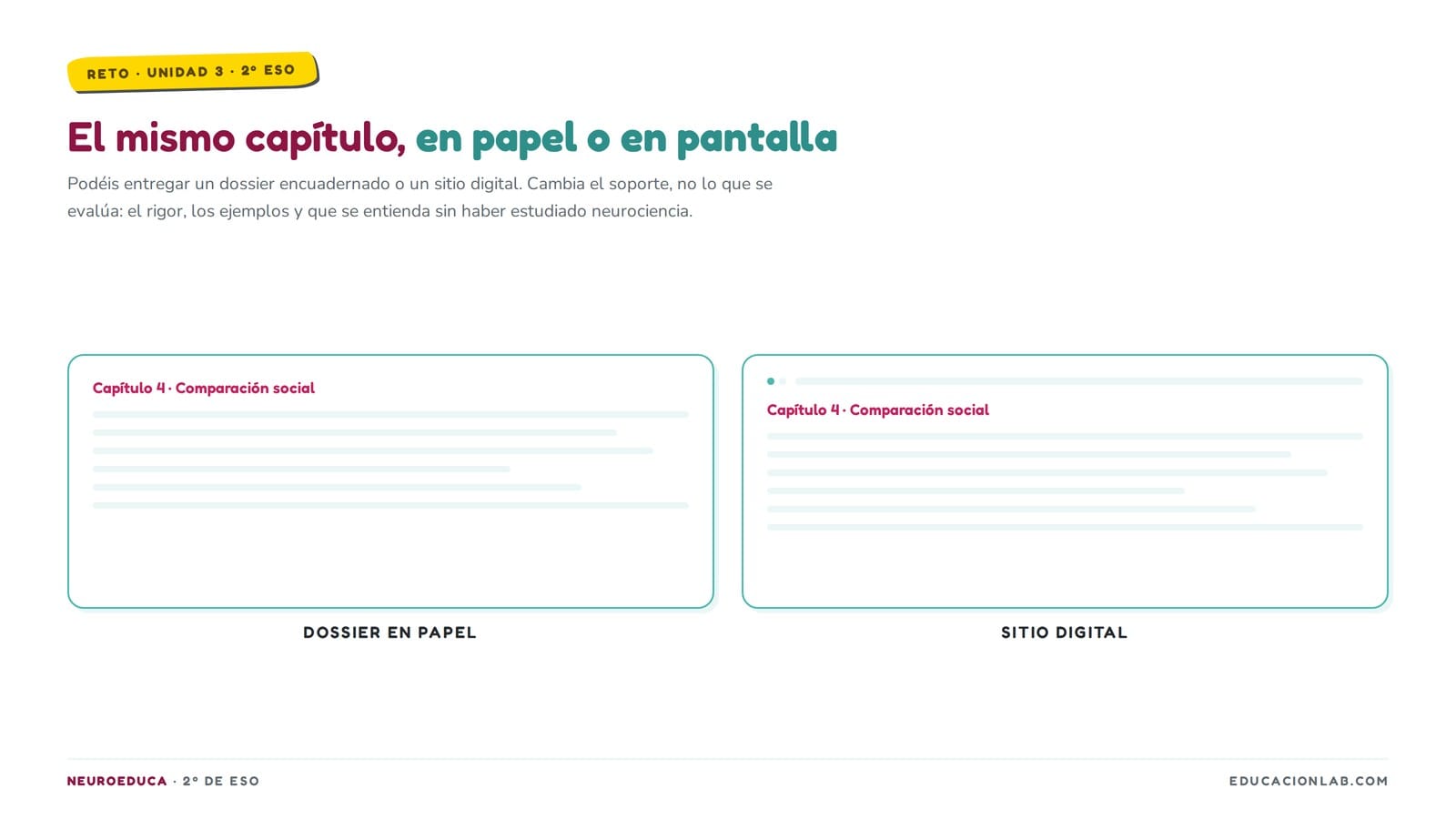
If you opt for a physical product, make a small bound dossier or notebook, with careful presentation, illustrations of your own or chosen with good judgement and a clear organisation that invites people to keep reading.
If you prefer a digital format, you can use Google Sites, Canva, Genially, PowerPoint or any similar tool.
What matters is not the app you use.
What matters is that anyone can read your chapter and understand it without having studied neuroscience.
The presentation is part of the learning too
When you finish the chapter, you will have to share it with others.
It can be with families, with another class or with your own classmates, as your teacher decides.
Don’t try to memorise a speech.
Try to understand the topic so well that you can explain it in your own words.
If, when you finish your presentation, someone thinks:
“Now I understand much better why this happens in a teenager.”
…you will have achieved your goal.
How will it be assessed?
The assessment will take into account both the product and the presentation.
It will value scientific rigour, the clarity of the explanations, the organisation of the chapter, the quality of the examples, cooperative work, the design of the product and your ability to communicate what you have learned.
The best way to get a good mark is not to make the most eye-catching chapter. It is to make sure whoever reads it understands the teenage brain better.
One last piece of advice
A few months ago, words like amygdala, prefrontal cortex, dopamine, brain plasticity or social brain probably seemed difficult to you.
Now you are the one who is going to use them to help other people.
And that means something very important has happened.
You are no longer studying just to pass.
You are learning to use knowledge to improve other people’s lives.
Perhaps that is the real goal of NeuroEduca.
Need one last hint?
If you have read the posts for the previous units, you already know what my advice will be.
YES… AGAIN.
Before writing a single word, open the rubric and the chapter template.
Then get your group together, share out the first responsibilities and start building your chapter.
When you have all finished yours, you will discover something very beautiful.
No group will have done “the best work”. Together, the group will have written a book that none of you could have created separately.
Frequently asked questions
Which chapters does the guide have?
Seven: how the brain builds identity, the social brain, shame and self-esteem, social comparison and social media, friendships, independence and family, and why we argue. Each group specialises in one and learns the rest by listening to the others.
What structure should each chapter follow?
The same one for everyone: start with a recognisable question or everyday situation, explain what happens in the brain using the concepts of the unit, add one or two relatable examples, suggest practical recommendations and close with a short key idea.
On paper or digital?
However each group prefers: a bound dossier or a site made with Google Sites, Canva, Genially or similar. What is assessed is the same in both cases: rigour, clarity, examples and that anyone can understand it without having studied neuroscience.
- Unit 0 Build your Survival Manual
- Unit 1 Build your Neuro-Emotional First Aid Kit
- Unit 2 Hack a habit
- Unit 3 Survival Guide to Understanding a Teenager (you are here)