

Challenge · Unit 2 · 2nd ESO
Hi! I’m going to confess something. When this challenge began I thought I would have to pick a “very important” habit to prove I was capable of changing. I even decided to stop looking at my phone at night.
I lasted… less than a day.
At first I thought I lacked willpower. Later I discovered the problem was something else. I was trying to change too much, too fast. That was when I understood an idea that will stay with me forever:
Would you rather read it? It is right below.
Before we start… let me give you a hint
My first Neuro-Challenge went terribly, and I think that is exactly why it can help you.
I chose to give up my phone in the afternoons. Completely. All at once. I lasted four days. On the fifth I quit and convinced myself I have no willpower.
That wasn’t it. The brain doesn’t change all at once: it changes by repeating small things. When I switched to “phone in another room while I do my homework”, I lasted a whole month.
And there is something that is reassuring to know from the start: here you are not assessed on whether you succeed. You are assessed on what you discover about your brain while you try. If you fail and can explain why you failed, the challenge is done.
A Neuro-Challenge is an experiment on yourself: you choose a small, checkable habit, design a plan, record your progress over several weeks and analyse the results. What is assessed is not whether the habit changes, but what you discover about how your own brain learns when it tries.
The brain doesn’t change all at once. It changes thanks to small actions we repeat many times.
And that means a habit doesn’t appear overnight. It is trained.
Start with a habit that really matters.
If I could give you one piece of advice before you start, it would be this.
Don’t choose a habit because it looks good in the project. Choose it because you think it could improve your life a little.
Maybe you want to go to bed a bit earlier, stop checking your phone as soon as you wake up, pack your bag the night before, start your homework without putting it off, cut down the time you spend on social media or manage to concentrate better when you study.
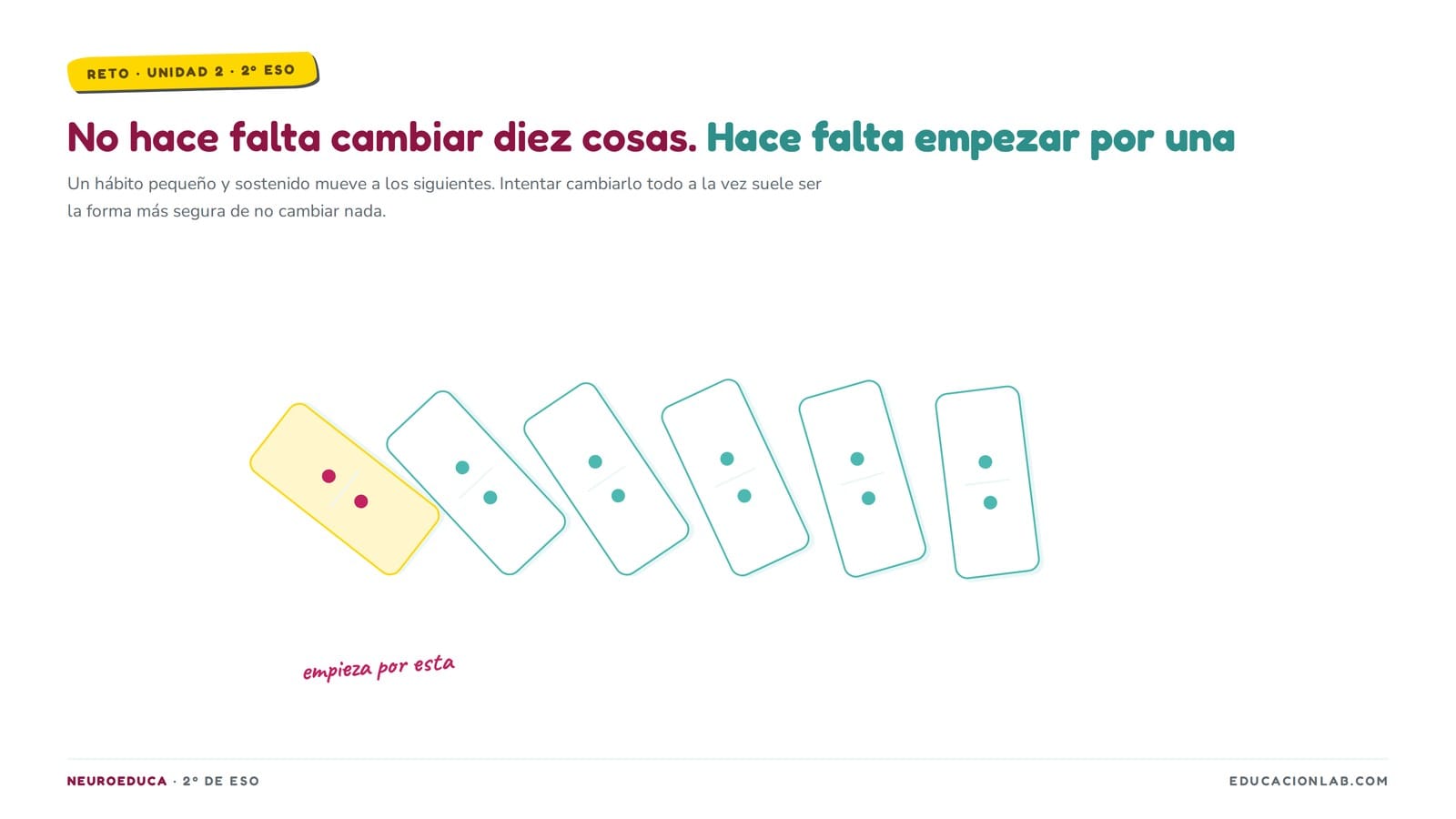
You don’t need to change ten things at once.
In fact, trying to do so is usually the best way to change none.
One single habit can start to change many other things.
There is one detail that can make a difference…
When I started this challenge I was convinced I would remember everything. I thought I would know perfectly which days I had met my goal and which I hadn’t.
I was wrong.
When I started recording what I did, I found things I hadn’t noticed. There were days when change was much easier. Others when the same excuse always showed up. Little by little I started to find out which situations helped my brain… and which made it go back to the old habit.
That was when I understood I was no longer doing a piece of work for class.
I was investigating my own brain.
That is why I recommend you record your progress honestly. It doesn’t matter if some days you don’t reach your goal. Those days also contain very valuable information.
What should the product be like?
I want to save you from another of the most common doubts.
What exactly do I have to hand in?
You can choose the format. It can be a notebook, a dossier, a creative journal, a fold-out poster or a digital product. What matters is not the design, but that anyone can understand the process you have followed.
Your Neuro-Challenge must tell a story: the story of a habit you have tried to change. So first you will present the habit you have chosen and explain why it is worth training from the brain’s point of view. Then you will describe the plan you have designed to achieve it and the small actions you will repeat every day.
Next you will record your progress over several weeks. You don’t need to write much each day; it is enough to note the most important data and the situations that helped or made the change harder. At the end, you will analyse all that information and write your conclusions. We are not looking for a perfect result. We want to find out what you have learned about the way you change habits and which strategies have worked best for you.
You are not keeping a diary. You are carrying out a small experiment on your own brain.
- Annotated rubric for the Neuro-ChallengePDF · 2 pages · printable
- Recording and tracking templatePDF · 3 pages · printable
Don’t fight your brain. Get it on your side.
There is one idea that surprised me a lot when we studied this unit.
I thought changing a habit was only a matter of trying harder. But I discovered that often the secret is making the right decision also the easiest one.
If you want to read more, leave the book on the table. If you want to use your phone less at night, keep it away from your bed. If you want to study before getting distracted, get your materials ready a few minutes before you start.
It seems like a small detail.
But those small changes also change the way your brain responds.
Sometimes changing your surroundings is more effective than trying to change your willpower.
If I had to start again…
I wouldn’t try to prove I can make a huge change.
I would try to be consistent with a small one.
Because that is what surprised me most when I finished the challenge. Not only did the habit change. The ease with which my brain started to repeat it changed too.
Then I truly understood what brain plasticity means. Every time we repeat a behaviour we strengthen the neural connections that make it possible. Little by little, what took a lot of effort at first starts to need less and less.
And that is also training the brain.
Before you hand it in…
When you finish your Neuro-Challenge, don’t think only about whether you managed to change the habit.
Ask yourself a much more interesting question.
What have I discovered about myself?
Perhaps you will find that tiredness has more influence than you imagined. Or that studying with your phone nearby is much harder. Or that small changes work better than big ones.
Whatever the answer, you will have achieved something much more important than finishing a project.
You will have learned a little more about how your own brain works.
One last thing…
I wish someone had told me this when I started.
There will be days when you don’t manage it.
And that’s fine.
A slip doesn’t erase all the ground you have covered.
Habits don’t change because one day you do something extraordinary. They change because you repeat something small many times.
Don’t try to prove you can change. Try to understand how your brain changes when you are consistent.
Because that will probably be the most important lesson of the whole unit.
Need one last hint?
Before opening the template or thinking about the design of the work, spend a few minutes choosing your habit well. Pick one that really makes sense to you, that you can keep up for several weeks and whose change could improve your day-to-day a little.
I found that the best project wasn’t the prettiest or the most original.
It was the one that kept helping me long after I had finished the unit.
Frequently asked questions
What is a Neuro-Challenge?
It is a project in which each student chooses a habit they want to train, explains what happens in their brain when a behaviour is repeated, designs a plan, records day by day what happens and ends by analysing what they have learned about themselves.
Which habit should you choose?
A small, specific one that you can check every day with a yes or a no. “Study more” doesn’t work; “start my homework before seven, Monday to Thursday” does. Huge goals get abandoned in the first week and leave the analysis with no material.
What if I don’t manage to change the habit?
That’s fine, and it doesn’t lower your mark. The failed days are the ones that give the most information: recording them and explaining what caused them is exactly what is assessed. What does count against you is an empty record or one filled in on the last day.
- Unit 0 Build your Survival Manual
- Unit 1 Build your Neuro-Emotional First Aid Kit
- Unit 2 Hack a habit (you are here)
- Unit 3 Survival Guide to Understanding a Teenager